
How to Choose Between Gate Valve and Butterfly Valve for Industrial Pipeline Systems
Choosing between a gate valve and a butterfly valve depends on pipeline size, operating conditions, maintenance requirements and lifecycle cost. Understanding the strengths of each valve helps engineers make more reliable design decisions.
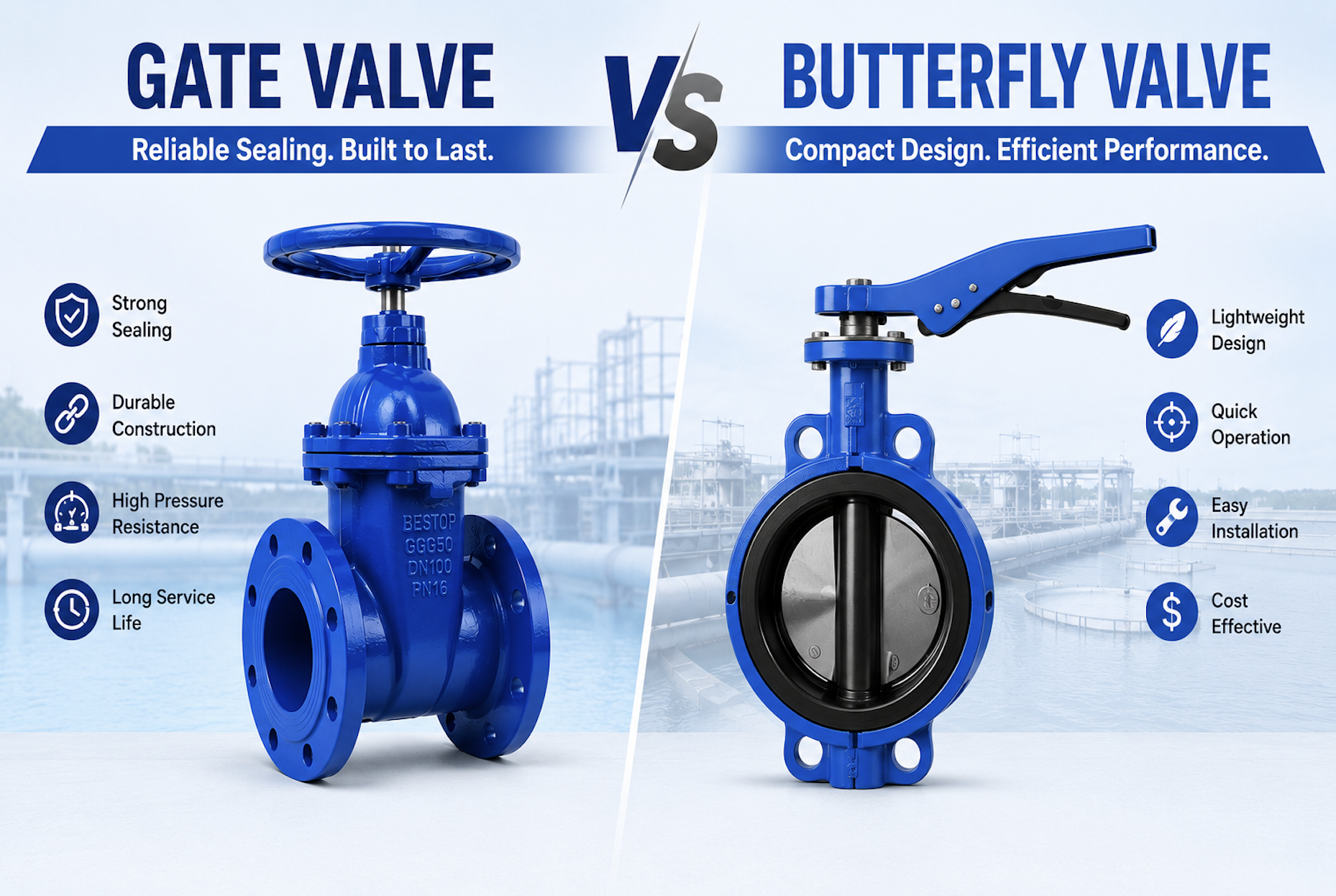
Should I use a gate valve or a butterfly valve?
There isn’t a universal answer. Both valves are widely used across municipal water, fire protection and industrial pipeline systems, but each is designed with different priorities in mind.
Rather than comparing prices alone, it’s more useful to look at how the valve will operate over the life of the project. Factors such as pipe size, available installation space, operating frequency and maintenance all influence the right choice.
A Common Situation on Site
Imagine a DN600 municipal water pipeline.
The project requires reliable shut-off, but the valve chamber has limited space and routine maintenance must be completed without specialised lifting equipment.
In this situation, many engineers would consider a butterfly valve because of its compact structure and lower weight.
Now imagine a long-distance transmission pipeline where pressure loss must be kept to a minimum and the valve may remain fully open for years. In that case, a gate valve is often the more suitable solution.
The best choice depends on the application—not on which valve is more popular.
Common Mistakes When Selecting Valves
From our experience working with customers in municipal water and industrial projects, a few selection mistakes appear repeatedly:
- • Choosing a valve based only on initial purchase price.
- • Ignoring installation space and actuator requirements.
- • Overlooking future maintenance access.
- • Using the same valve type across every part of a pipeline without considering operating conditions.
- • Focusing on specifications while overlooking supplier quality control and testing.
A valve may perform well on paper, but reliable performance depends on both correct selection and consistent manufacturing quality.
Our Perspective
Every project has different priorities.
Some customers focus on reducing installation costs, while others place greater importance on long-term reliability or compliance with local standards.
Because of this, we encourage customers to evaluate valve selection from the perspective of the entire pipeline system rather than comparing individual products in isolation.
This approach often leads to lower lifecycle costs and fewer maintenance issues over time.
BESTOP supplies gate valves, butterfly valves and complete pipeline products for municipal water, fire protection and industrial applications worldwide.
Frequently Asked Questions
1. Is a gate valve always better than a butterfly valve?
No. A gate valve provides full-port flow and is well suited for isolation, while a butterfly valve is often preferred where space, weight and operating efficiency are important. The better option depends on the application.
2. Why are butterfly valves commonly used on large pipelines?
Their compact design, lighter weight and quarter-turn operation make installation and maintenance easier, particularly on larger diameter pipelines.
3. Can butterfly valves be used for isolation?
Yes. In many municipal water, HVAC and industrial systems, butterfly valves are widely used as isolation valves when selected for the correct pressure and service conditions.
4. What should be considered before selecting a valve?
Typical considerations include:
- Pipe diameter
- Pressure rating
- Flow media
- Operating frequency
- Available installation space
- Maintenance requirements
- Applicable industry standards
5. Should valve selection focus on purchase price?
Purchase price is only one factor. Installation, maintenance, service life and operational reliability usually have a greater impact on the total cost of ownership.
People Also Ask
- • What is the difference between a gate valve and a butterfly valve?
- • Which valve is better for municipal water systems?
- • Why do engineers use butterfly valves in large pipelines?
- • When should a gate valve be selected?
- • Can a butterfly valve replace a gate valve?
- • Which valve has lower pressure loss?
- • What factors should be considered when selecting an industrial valve?
- • Are butterfly valves suitable for fire protection systems?
- • How do valve size and operating conditions affect valve selection?
- • What are the most common valve types used in pipeline systems?
Post time: Jul-14-2026